
Business Process Improvement: How to Identify and Prioritize Operational Problems
Business process improvement is the structured practice of identifying where a process underperforms, understanding its root causes, changing how the process operates, and measuring whether the change improves the intended business outcome.
It is not automatically the same as buying software, adding automation, documenting more steps, or redesigning every workflow. The practical question is: which operational problem should the company solve first, and what type of change does it require?
What Is Business Process Improvement?
A business process is a repeatable sequence of work that turns an input into an intended outcome. It may involve people, information, systems, approvals, decisions, reports, and departmental handoffs.
Improvement may mean reducing unnecessary effort, clarifying ownership, improving data quality, shortening delays, standardizing decisions, redesigning handoffs, or creating better visibility.
Automation may support the improved process, but it is only one possible intervention.
This reflects the broader ISO process approach, which emphasizes managing connected processes, measuring performance, and improving them using evidence.
The distinction between symptoms and root causes matters. A report that takes six hours to prepare is a symptom. The underlying cause may be disconnected data, inconsistent definitions, unclear ownership, or repeated corrections. Improving the spreadsheet alone would not necessarily solve those problems.
Signs a Business Process Needs Improvement
Teams should look for repeated operational patterns rather than isolated inconveniences:
Reports consistently take too long to prepare.
Employees enter the same information in multiple systems.
Approvals depend on reminders and follow-ups.
Systems show conflicting information.
Work waits between departments without a clear owner.
Exceptions occur frequently without a defined response.
Customers experience avoidable delays.
Automation requires regular manual correction.
Leadership cannot see where work is blocked.
These signals justify investigation, not an immediate software purchase.
Business Process Analysis vs. Business Process Improvement
Business process analysis examines how work operates and why it underperforms. Business process improvement uses those findings to change how the work should operate.
| Discipline | Purpose | Typical output |
|---|---|---|
| Business process mapping | Document the current flow | Current-state process map |
| Business process analysis | Identify root causes, risks, delays, and dependencies | Problem diagnosis |
| Business process improvement | Select and implement operational changes | Prioritized improvement plan |
| Workflow design | Define future ownership, rules, and handoffs | Future-state workflow |
| Workflow automation | Execute defined steps through technology | Automated actions and integrations |
A business process map can reveal where work breaks. Analysis and prioritization determine what should be improved first.
Business Process Improvement Steps
1. Define the business outcome. Establish what the process should produce, such as accurate
reporting, a complete handoff, or reliable inventory visibility.
2. Select one process. Choose a workflow with a clear beginning and outcome instead of
attempting to improve an entire department.
3. Map the current process. Document how work actually moves, including informal workarounds and exceptions.
4. Collect evidence. Review delays, rework, errors, complaints, reporting effort, and employee
observations.
5. Identify root causes. Separate the visible problem from the operating condition creating it.
6. Evaluate dependencies and exceptions. Review upstream information, approvals, systems,
teams, and nonstandard scenarios.
7. Prioritize opportunities. Compare frequency, effort, business impact, customer impact, risk, and readiness.
8. Select the intervention. Decide whether to correct, simplify, standardize, redesign, integrate,
automate, or retire the process.
9. Assign ownership. Name the person accountable for the outcome, implementation, and future exceptions.
10. Establish success measures. Use relevant measures such as cycle time, errors, rework,
completion quality, or exception volume.
11. Implement in a controlled sequence. Test changes at a manageable scale rather than changing every operational layer simultaneously.
12. Review the result. Compare performance with the original baseline and check for unintended consequences.
The Plan-Do-Check-Act cycle provides a useful model for testing and refining operational changes.
How to Prioritize Which Process to Improve First
| Criterion | Question to ask |
|---|---|
| Frequency | How often does the process run or the problem occur? |
| Manual effort | How much employee effort does it require? |
| Business impact | Which revenue, cost, delivery, or strategic outcome is affected? |
| Customer impact | Does it affect speed, quality, or customer confidence? |
| Risk | Could it create financial, compliance, security, or delivery risk? |
| Visibility | Does it prevent teams from understanding performance? |
| Process clarity | Are the trigger, owners, steps, and outcome understood? |
| Dependencies | Which teams, tools, and data sources are involved? |
| Readiness | Are the owners available and decisions sufficiently clear? |
| Implementation effort | What time, expertise, and change are required? |
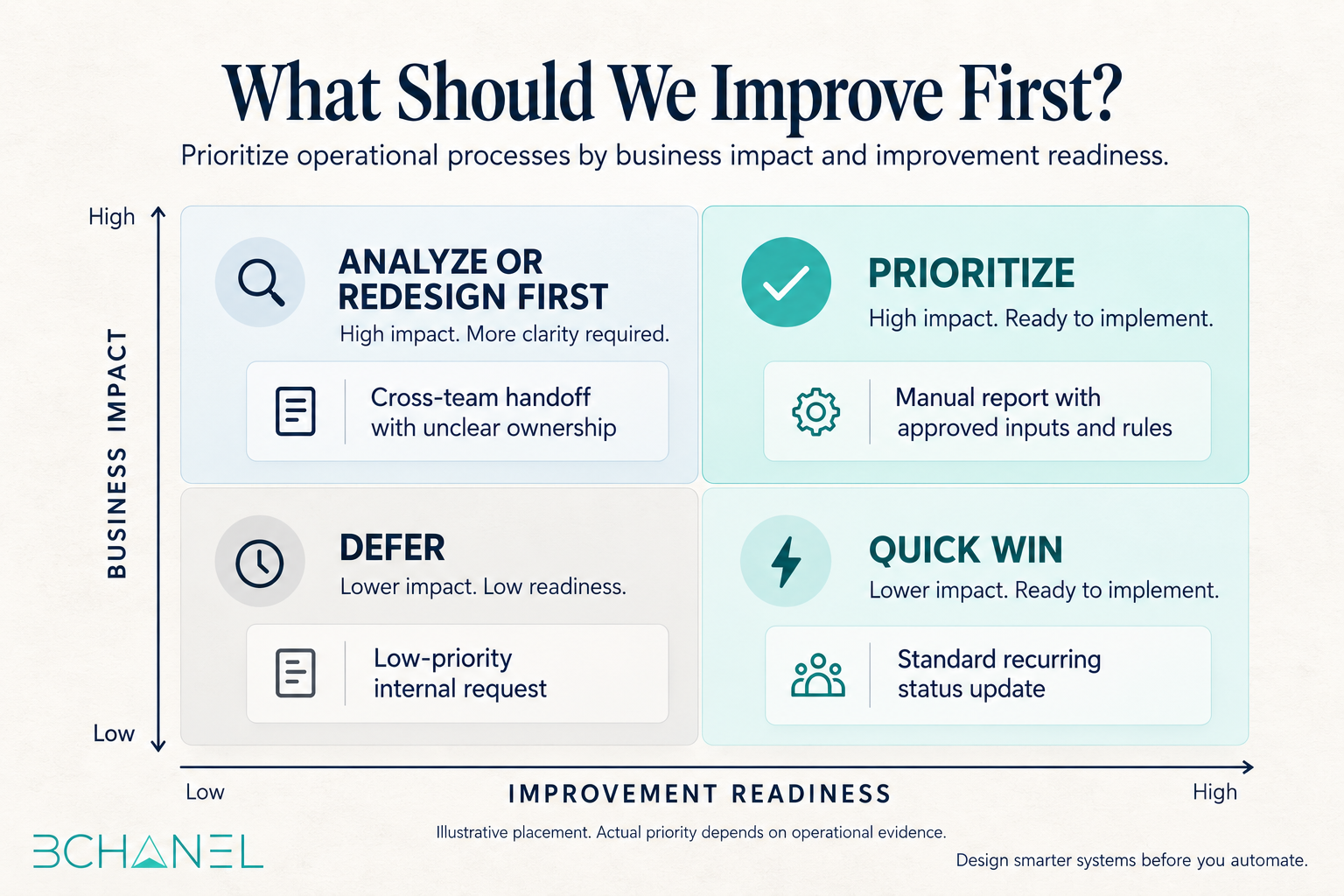
Use the findings to classify each opportunity:
High impact and high readiness: prioritize.
High impact and low readiness: analyze or redesign first.
Low impact and high readiness: consider as a quick win.
Low impact and low readiness: defer unless its risk changes.
When multiple systems and data flows are involved, system design for growing operations can clarify how workflows, ownership, tools, and visibility should work together.
Business Process Improvement Examples
Amazon Ads Reporting Automation
Reporting across eight Amazon brands required manual downloads and spreadsheet calculations, consuming approximately four to eight hours every week.
The workflow needed defined inputs, calculation logic, reporting frequency, and a consistent output.
BChanel redesigned and automated the collection, calculation, and delivery process. The result was one consolidated report covering all eight brands every Monday.
Review the Amazon Ads Reporting Automation workflow case.
Client Onboarding Automation
Client and project information was entered manually across HubSpot or GHL, ClickUp, Slack, Google Sheets, and QuickBooks. Sales, Delivery, and Finance depended on a fragmented handoff.
The workflow required a defined trigger, required client information, team ownership, and rules for creating projects and invoices. BChanel connected the systems and supported automatic project and invoice creation. The redesigned workflow reduced the handoff from 11 steps to two.
Review the Client Onboarding Automation workflow case.
Conceptual Examples
An ecommerce inventory process may require teams to check Shopify, Amazon, a 3PL portal, and spreadsheets. Before integration, the company should define which system owns each inventory status and how discrepancies are handled.
A finance reconciliation process may depend on inconsistent transaction categories and incomplete source data. Before automation, the team should standardize categorization, validation, ownership, and exception rules.
Additional BChanel workflow cases show how operational problems can be translated into clearer workflows and implementation decisions.
What Should Be Fixed Before It Is Automated?
Before automation, teams should clarify the process trigger, owner, required information, source of truth, approval rules, exceptions, reporting requirements, and expected outcome.
Automation can execute rules and move information. It cannot determine how an unclear process should operate. This is why workflow automation works better after workflow design.
Common mistakes include starting with software, improving too many processes simultaneously, mapping only the ideal path, excluding the employees who perform the work, measuring activity instead of outcomes, and treating documentation as the final result.
When External Process Improvement Support May Help
Process improvement consulting may be useful when the problem crosses departments, teams disagree about the root cause, previous automation attempts failed, leadership needs independent prioritization, or a technology decision depends on operational clarification.
External support should begin by understanding the problem and selecting the appropriate
intervention—not with a predetermined tool.
The BChanel Perspective
BChanel’s process improvement approach follows five practical steps, supported by three service layers:
Operational Assessment, Workflow Architecture, and Automation Systems.
The approach is to assess how work operates, identify bottlenecks and visibility gaps, prioritize what should be fixed, redesign the workflow, and automate only the components that are ready.
BChanel’s Operational Assessment, Workflow Architecture, and Automation Systems support the different stages of this process.
Not Sure Which Process Should Be Improved First?
BChanel’s Workflow Diagnostic helps you review one workflow, identify its main points of friction, and
understand whether it needs clarification, redesign, integration, or automation.
Check Your Workflow
[WORKFLOW DIAGNOSTIC URL]
FAQ
What is business process improvement?
It is the structured practice of identifying why a process underperforms, changing how it operates, and measuring whether the change improves the intended outcome.
How do you identify a process that needs improvement?
Look for repeated delays, duplicate data entry, manual reporting, unclear ownership, frequent
exceptions, customer complaints, inconsistent data, or work waiting between teams.
What is the difference between process improvement and process mapping?
Process mapping documents how work currently moves. Process improvement uses that understanding to decide what should change and which improvements should happen first.
What is the difference between process improvement and automation?
Process improvement changes how work operates. Automation uses technology to execute defined steps. A process can be improved without being automated.
Which business process should a company improve first?
Prioritize a process that combines meaningful business, customer, visibility, or risk impact with sufficient evidence and implementation readiness.
When should a company hire a process improvement consultant?
External support may help when a problem crosses departments, the root cause is disputed, previous automation failed, or the internal team lacks time to analyze and redesign the workflow.