
Operational Assessment, Workflow Architecture, and Automation Systems.
BChanel helps growing teams assess operations, redesign workflows, and build automation systems once workflows, ownership, and data structure are clear. See BChanel's operational clarity approach for how we sequence this work.
CORE SERVICES
Three core services, from assessment to automation
BChanel begins by understanding how work operates today, then redesigns the workflow and operating structure before implementing automation.
Operational Assessment
When to use it
When you are not sure what is slowing work down, where visibility is being lost, or what should be fixed first.
What you get
Workflow review, bottleneck map, visibility gap analysis, and a prioritized improvement roadmap.
Start with an Assessment →Workflow Architecture
When to use it
When ownership, handoffs, approvals, reporting, or the overall process structure are unclear.
What you get
Workflow maps, ownership model, redesigned handoffs, approval paths, and operating structure.
Design the Workflow →Automation Systems
When to use it
When workflows are clearly defined and the team is ready to remove repetitive manual work.
What you get
Automated handoffs, reporting workflows, system integrations, alerts, and task automation.
Explore Automation Systems →01 / OPERATIONAL ASSESSMENT
Understand where work is slowing down.
We review how work currently moves across people, tools, systems, reports, and manual steps. The assessment identifies workflow bottlenecks, unclear ownership, visibility gaps, and processes that may be ready for automation.
Best for
Manual reporting, spreadsheet dependency, unclear ownership, poor handoffs, repetitive work, and limited operational visibility.
What we review
Workflows, tools, ownership, handoffs, bottlenecks, reporting, data movement, and repetitive manual tasks.
What you receive
Workflow assessment, bottleneck map, visibility gap analysis, and a prioritized operational improvement roadmap.
02 / WORKFLOW ARCHITECTURE
Redesign how work should move across the business.
We design clearer workflows, ownership, handoffs, approval paths, reporting logic, and system interactions before automation is implemented.
Best for
Unclear handoffs, ownership gaps, approval bottlenecks, inconsistent processes, disconnected teams, and undefined operating structures.
What we design
Workflow maps, ownership models, approval paths, reporting logic, system interactions, data flows, and redesigned handoffs.
What you receive
Documented workflow architecture, clearer ownership, redesigned processes, and a more scalable operating structure.
03 / AUTOMATION SYSTEMS
Automate the right processes after the workflow is clear.
Once the workflow, ownership, data, and approval rules are defined, we implement automation systems that reduce repetitive work and improve operational visibility.
Best for
Repetitive tasks, redundant data entry, manual reporting, delayed handoffs, disconnected updates, and teams ready to automate a defined workflow.
What we build
Automated handoffs, reporting workflows, task automation, system integrations, alerts, and CRM or operational automations.
What you receive
Reduced manual work, cleaner reporting, faster handoffs, improved visibility, and automation aligned with the operating structure.
SUPPORTING CAPABILITIES
Capabilities that support the three core services
System integration and AI readiness are introduced when they support the assessed workflow. They strengthen the core engagement but are not separate starting points.
System & Data Integration
Used when disconnected tools, duplicate data, or manual reporting prevent teams from having one reliable operating view.
Includes: System connection mapping, data-flow design, source-of-truth planning, integrations, and reporting visibility.
AI Agent Readiness
Used after workflows, data access, ownership, approval rules, and escalation paths have been clearly defined.
Includes: Agent use-case definition, workflow-agent mapping, approval requirements, readiness planning, and implementation priorities.
Explore AgenticOS →Not sure what should be fixed first?
Most clients begin with an Operational Assessment. It identifies what is slowing work down, what needs to be redesigned, and which processes may be ready for automation.
Book an Operational Assessment →See how these services work in real workflows
Explore real examples of how BChanel helps teams clarify workflows, improve visibility, connect systems, and automate the right processes.
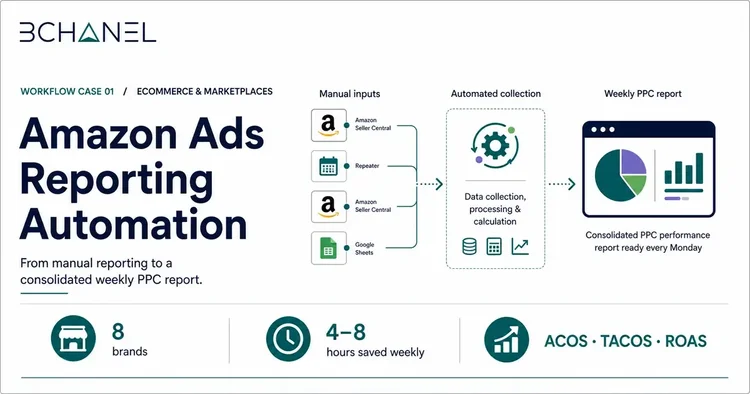
Home Pick
The ads team was spending 4-8 hours every Monday pulling reports manually across 8 Amazon brands. We built an end-to-end automation that collects, calculates, and delivers a consolidated report before the week begins.
View the Home Pick Workflow Case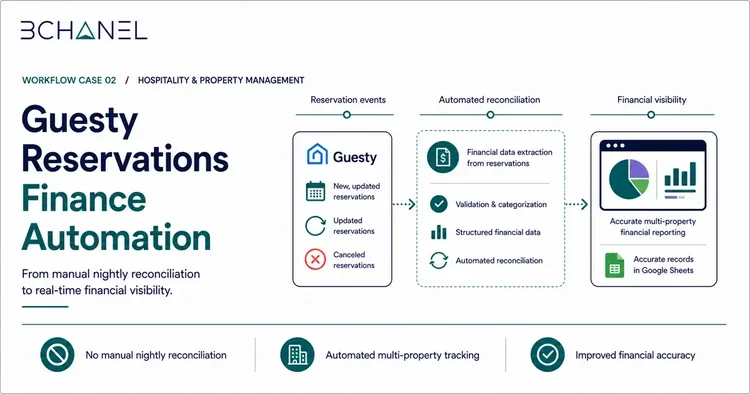
TAIMS
Finance data across every property was extracted and reconciled by hand each night. We built a real-time automation that listens to Guesty reservation events, validates financials, and updates a live dashboard.
View the TAIMS Workflow Case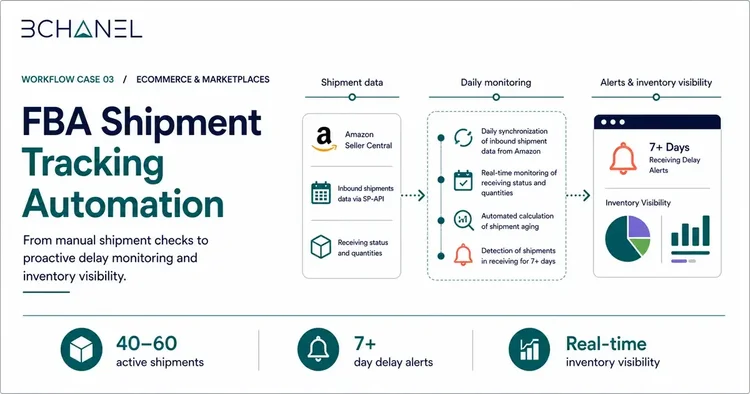
FBA Shipment Tracking
The logistics team manually checked Amazon Seller Central every day to track 40-60 inbound shipments across multiple brands. We built an automated workflow using the Amazon SP-API to monitor status and detect delays early.
View the FBA Shipment Tracking Workflow Case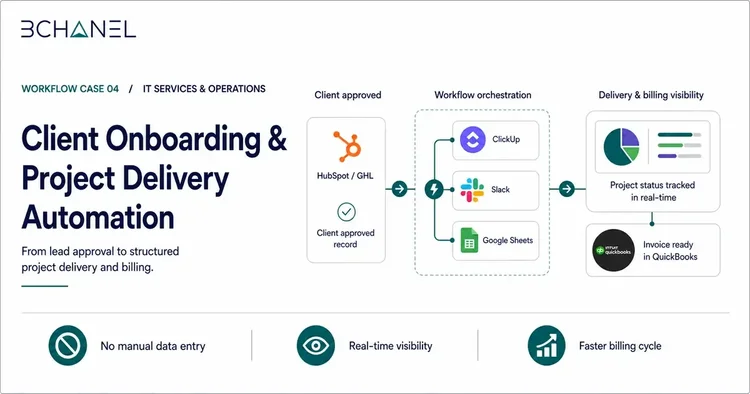
Client Onboarding & Project Delivery
IT service teams were manually handing off between Sales, Delivery and Finance across multiple systems. We connected HubSpot/GHL, ClickUp, Slack, Sheets and QuickBooks so everything flows automatically.
View the Client Onboarding Workflow CaseOPERATIONAL ASSESSMENT
Ready to understand what should be fixed first?
If your team relies on manual reporting, disconnected systems, unclear ownership, or repetitive work, BChanel can help identify the highest-priority operational improvements.
Book an Operational Assessment → Read more in our BChanel Success Stories.