
AI agents are becoming more attractive for growing companies because the promise is simple: less manual work, faster execution, and more operational leverage.
But there is a problem.
AI agents are only useful when the operating environment around them is clear enough to trust. If workflows are unclear, data is unreliable, approvals are informal, and ownership is scattered across teams, an AI agent will not magically fix the business. It may simply move confusion faster.
That is why AI readiness is not just a technology question. It is an operational readiness question.
Before a company asks, "What can an AI agent do for us?" it should ask, "Is our operating layer clear enough for an agent to support safely?"
That is the core idea behind AgenticOS Readiness.
AI Agents Need More Than Prompts
Many teams approach AI adoption from the wrong starting point. They focus on prompts, tools, models, or use cases before understanding whether the business has the workflow structure required for advanced automation.
A prompt can help an agent respond. A tool can give access. A model can process information.
A workflow tells the agent what should happen next. Ownership defines who is responsible. Reliable data tells it what to trust.
Without that foundation, AI agents can create risk instead of efficiency. They may pull from the wrong data source. They may trigger a task before approval is clear. They may update the wrong system. They may summarize incomplete information. Or they may require so much human checking that the team has not really saved time.
The issue is not that AI agents are weak. The issue is that many businesses are not operationally ready for them yet.
Operational Clarity Comes Before AI Readiness
For AI agents to support execution, the business needs clear operational logic. That means the team understands how work moves, where data lives, who owns each step, and which decisions require approval.
This is similar to the broader principle behind operational assessment before automation — before adding technology, teams need to understand what is actually breaking. The same applies to AI agents.
If a company wants an agent to help with client onboarding, the onboarding workflow must already be clear. If a company wants an agent to help with fulfillment updates, order status, inventory, and fulfillment data need to be reliable. If a company wants an agent to help with reporting, the team needs to trust where the numbers come from.
If those pieces are not clear, the agent is not solving the core problem. It is operating inside it.
The Workflow Has to Be Clear
The first requirement for AgenticOS Readiness is workflow clarity. An AI agent needs to understand what sequence of work it is supporting.
For example, in an IT services company, a client onboarding workflow may include sales handoff, context capture, project setup, owner assignment, finance details, kickoff communication, and delivery status visibility.
If those steps are not clearly defined, an AI agent cannot support onboarding safely. It may create a project without the right scope. It may send a client update before the delivery owner is assigned. It may miss billing context that finance needs later.
This is why the CRM-to-delivery handoff matters so much — we covered this in more detail in the CRM-to-project handoff problem in IT services companies.
The same logic applies to ecommerce. If an agent is expected to help with order updates, the workflow behind orders, inventory, fulfillment, support, and reporting needs to be clear first. Otherwise, the agent may become another layer on top of disconnected operations.
Ownership Has to Be Defined
AI agents also need clear ownership around the work they support. This is where many teams underestimate the operational side of AI readiness.
An agent may be able to draft a message, update a record, summarize a ticket, or trigger a next step. But who owns the outcome? Who reviews exceptions? Who approves the action? Who is responsible if the information is wrong? Who decides when a task should stay human?
If ownership is unclear, the agent creates more ambiguity.
This matters because many workflow problems already come from unclear ownership. A task moves from sales to delivery, but nobody owns the handoff. A report is expected, but nobody owns the source data. A support update is needed, but nobody owns the fulfillment context.
AI agents do not remove the need for accountability. They make accountability more important.
Before delegating work to agents, teams need to define which steps can be automated, which require review, and which person or team remains responsible.
Reliable Data Is Not Optional
AI agents are only as reliable as the information they can access.
If the same number appears differently across Shopify, an ERP, a spreadsheet, and a finance tool, the agent needs to know which source to trust. If project status lives partly in Jira, partly in Slack, and partly in someone's head, the agent cannot produce a reliable delivery summary. If reporting is rebuilt manually every week, the agent may only automate a fragile reporting process.
This is why manual reporting is often a warning sign. In our article on manual reporting as a visibility problem, we explained that manual reports usually point to disconnected systems, unclear data ownership, and weak visibility. That same issue affects AI readiness.
If the business does not trust the data, it should not expect an agent to trust it either.
Before implementing AI agents, teams should review:
Which systems hold critical data
Which source is considered accurate
Who owns each data point
How updates move between systems
Where manual checks still happen
Which numbers leadership does not fully trust
Reliable data is not a technical detail. It is an operating requirement.
Approval Paths Need to Be Designed
AI agents should not have unlimited freedom to act. For most growing businesses, the safest and most useful agentic workflows include clear approval paths.
Some actions may be safe to automate fully. Others should be drafted by the agent but approved by a human. Some should only trigger alerts or recommendations.
This matters in both ecommerce and service operations. An agent may be able to identify delayed orders, but should it automatically contact the customer? An agent may summarize a project risk, but should it update the client without review? An agent may detect a billing issue, but should it notify finance, pause delivery, or escalate to leadership?
These are workflow architecture questions. They define how advanced automation should operate inside the business.
Without approval paths, agents can either become too risky or too limited. With clear approval paths, they can support execution while keeping the business in control.
Where AI Agents Can Help Once the Foundation Is Clear
Once workflows, ownership, data, and approvals are clear, AI agents can become much more useful. They can:
Summarize operational updates
Identify exceptions
Draft client communications
Route tasks to the right owner
Surface reporting issues
Support onboarding checklists
Monitor workflow status
Reduce the need for repeated manual follow-up
But these use cases only work well when the business has already designed the operating logic behind them.
For example, an agent can support ecommerce fulfillment visibility if order status, inventory, fulfillment updates, and support context are already structured. An agent can support IT client onboarding if sales context, project setup, owner assignment, and client communication rules are already defined. An agent can support reporting if the source data is reliable and ownership is clear.
This is why AgenticOS Readiness is not about chasing AI use cases. It is about preparing the operating foundation those use cases require.
AgenticOS Readiness Is an Operating Layer
At BChanel, we see AgenticOS Readiness as the next layer after operational assessment, workflow architecture, and automation systems. It is not a replacement for those foundations. It depends on them.
Operational assessment helps identify where work breaks. Workflow architecture defines how work should move. Automation systems help implement structured workflows. AgenticOS Readiness prepares the environment where AI agents can support execution safely.
That means reviewing workflows, data flows, ownership, approvals, exceptions, and system structure before advanced automation is added.
This is also why workflow architecture examples matter. They show the real operating problems behind automation: fulfillment visibility, client onboarding, reporting gaps, system handoffs, and ownership breakdowns.
AI agents are not separate from those problems. They need those problems solved clearly enough to work inside them.
The BChanel Perspective
AI agents can create real leverage for growing companies. But only when the business is ready for them.
If workflows are unclear, the agent will inherit the confusion. If ownership is scattered, the agent will create more follow-up. If data is unreliable, the agent will produce unreliable output. If approvals are informal, the agent will operate in a risky environment.
That is why the first step is not always choosing an AI tool. The first step is reviewing whether the operating layer is ready.
At BChanel, AgenticOS Readiness means helping teams understand what needs to be clarified before AI agents or advanced automation are added. The goal is not to use AI faster. The goal is to make sure AI can support the business safely, clearly, and usefully.
FAQ
What is AgenticOS Readiness?
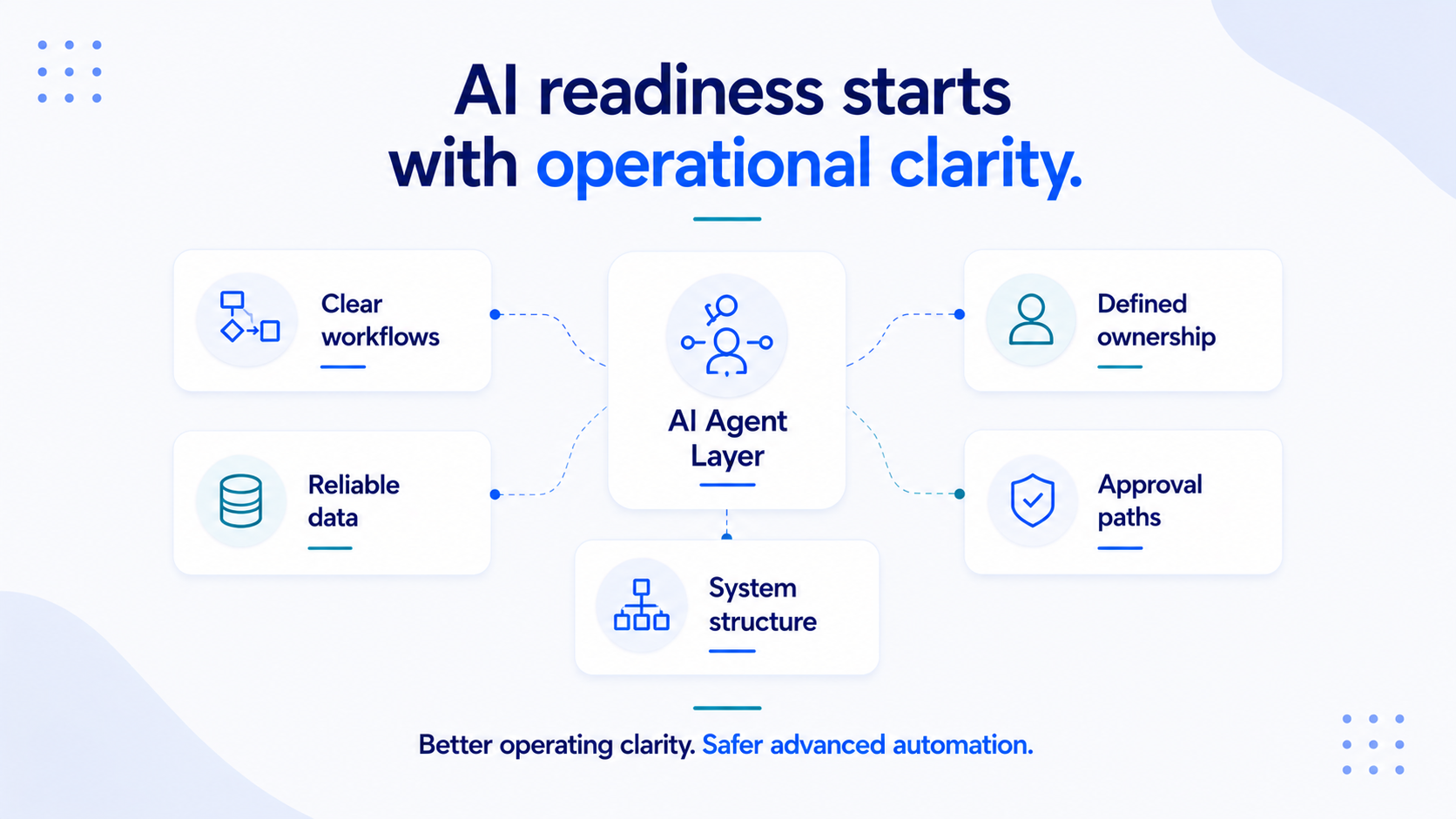
AgenticOS Readiness is the operating foundation a business needs before AI agents can safely support execution. It includes clear workflows, defined ownership, reliable data, approval paths, and structured system flows.
Why do AI agents need clear workflows?
AI agents need clear workflows because they need to understand what should happen next, which system to use, who owns each step, and when human approval is required.
Can AI agents fix messy operations?
Not by themselves. AI agents can support structured operations, but if workflows, data, and ownership are unclear, they may make the confusion move faster.
What should teams review before using AI agents?
Teams should review workflow clarity, data reliability, ownership, system access, approval paths, exception handling, and reporting visibility before implementing AI agents.
How does BChanel help with AI readiness?
BChanel helps teams assess operational readiness, redesign workflows, clarify ownership, improve visibility, and prepare the operating layer needed for advanced automation and AI agents.