
AI Agents vs. Workflow Automation: How to Choose the Right Approach for Business Operations
AI agents are attracting attention across business operations, but not every workflow needs one. Many operational problems can still be solved more reliably with fixed-rule workflow automation. Others require interpretation, context, and controlled judgment—areas where an AI agent may add value.
The right question is not which technology is more advanced. It is how the work actually decides what should happen next.
Choosing between AI agents and automation starts with the workflow: its inputs, decisions, exceptions, ownership, data, and risk. In some cases, the best solution is neither one nor the other but a controlled combination of automation, agent interpretation, and human approval.
AI agents vs. automation: the short answer
Use workflow automation when defined inputs consistently lead to predictable actions. Consider an AI agent when the next action depends on variable information that must be interpreted. Keep a human involved when decisions carry financial, operational, legal, or customer risk.
Technology should follow the decision structure of the work—not the current trend.
What is workflow automation?
Workflow automation moves work through predefined rules, triggers, and actions.
For example, when a deal is approved and all required fields are complete, an automation can create a draft invoice, update the project system, and notify the finance team. The conditions are known, the inputs are structured, and the expected output is consistent.
Workflow automation is typically the better choice when:
The trigger is clearly defined.
Inputs follow a consistent structure.
Business rules are stable.
The same conditions should produce the same action.
Exceptions are limited and already documented.
The output can be tested objectively.
A reporting process that collects data from known sources, applies approved calculations, and produces a recurring report is usually an automation problem. BChanel’s Amazon Ads Reporting Automation workflow case demonstrates this pattern in practice.
What is an AI agent?
An AI agent is useful when software must interpret information, evaluate context, and select an appropriate next step within defined boundaries.
Consider an incoming customer request. The message may be incomplete, written differently each time, or involve several possible workflows. An agent could classify the request, identify missing information, and route it to the correct next step.
This does not mean the agent should make every decision independently. A well-designed AI agent workflow defines:
Which information the agent can access.
Which actions it can perform.
Which rules it must follow.
When it should request more information.
When it must escalate to a person.
How its activity will be monitored.
An agent should interpret within an operating structure—not compensate for the absence of one.
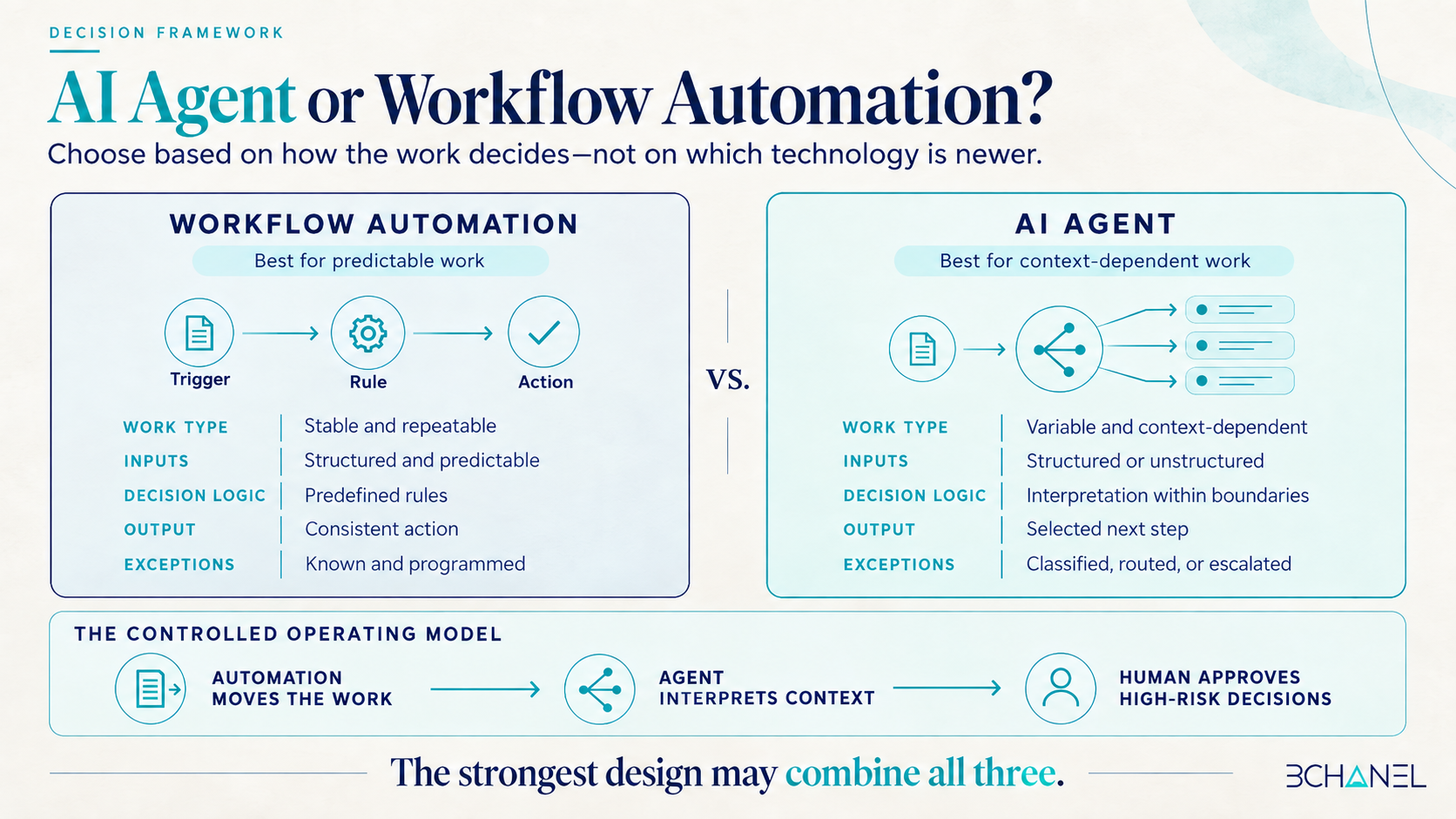
| Decision factor | Workflow automation | AI agent |
|---|---|---|
| Best suited for | Stable, repeatable processes | Context-dependent work |
| Inputs | Structured and predictable | Variable or unstructured |
| Decision logic | Predefined rules | Interpretation within boundaries |
| Output | Consistent action | Selected next step |
| Exceptions | Known and programmed | Classified, routed, or escalated |
| Human involvement | Review at defined stages | Approval when confidence or risk requires it |
| Main risk | Incorrect or outdated rules | Uncontrolled interpretation or action |
This comparison is not about replacing automation with AI agents. It is about assigning each layer the right responsibility.
Four questions to ask before choosing
1. Does the workflow follow stable rules?
Start by mapping the current process.
If the workflow can be expressed as “when this happens, perform that action,” fixed-rule automation may be sufficient. Adding an agent to a deterministic process can increase cost, variability, and monitoring requirements without improving the outcome.
2. Does the next action require interpretation?
An AI agent may be appropriate when the workflow receives variable information and the next step cannot be selected through a simple decision tree.
Examples include classifying complex requests, summarizing operational context, identifying missing information, or recommending a route based on several inputs. The agent should still work from approved sources and within defined limits.
3. What happens when the agent is uncertain?
Every agentic workflow needs an exception path.
The design should define when the agent can proceed, when it should pause, and when a human must review the decision. Confidence thresholds alone are not enough; the workflow must also account for business impact.
The NIST AI Risk Management Framework provides a useful reference for incorporating trustworthiness and risk considerations into the design, deployment, and evaluation of AI systems.
4. Are the workflow and data ready?
AI agents for business depend on clear operating foundations. Before implementation, confirm that:
The workflow has an owner.
Approved data sources are identified.
Access permissions are controlled.
Decision boundaries are documented.
Exceptions and escalation paths are defined.
Agent actions can be monitored.
A human can intervene when necessary.
If ownership is unclear or the data cannot be trusted, an agent may amplify the existing operational problem.
The strongest design may combine all three layers
Many business operations do not require an all-or-nothing choice.
A controlled workflow might use:
Automation to move the work: Collect information, update systems, and trigger the process.
An AI agent to interpret context: Classify the request, identify missing information, or recommend a route.
A human to approve higher-risk decisions: Review financial commitments, unusual exceptions, or customer-sensitive actions.
This model keeps predictable work deterministic while using an agent only where interpretation adds value.
Assess the workflow before selecting the technology
The most important work happens before implementation.
Map how the process operates today. Identify its decisions, inputs, dependencies, exceptions, and owners. Then determine which steps should remain manual, which can follow fixed rules, and which genuinely require interpretation.
Ready to evaluate your operation?
Review BChanel’s AI Agent Readiness framework to compare your workflows, data, ownership, approval rules, and reporting structure against the foundations required for agentic execution. If the gaps reflect your current operation, you can request a readiness review from the same page.
Frequently Asked Questions About AI Agents and Workflow Automation
1. What is the difference between an AI agent and workflow automation?
Workflow automation follows predefined triggers, conditions, and actions. An AI agent can interpret variable information and select a next step within defined boundaries. Automation is best for predictable work; agents are better suited to context-dependent tasks.
2. Are AI agents better than traditional automation?
No. AI agents are not inherently better. Traditional automation is often more reliable, explainable, and cost-effective for stable processes. An agent becomes useful when fixed rules cannot reasonably handle the variation or interpretation required.
3. When should a business use an AI agent?
A business should consider an AI agent when a workflow receives variable inputs, requires contextual interpretation, has multiple possible next steps, and includes clear approval and escalation boundaries.
4. Can AI agents and workflow automation work together?
Yes. Automation can collect data and move work between systems, while an AI agent interprets information or recommends the next action. Humans can remain responsible for exceptions and high-risk approvals.
5. How do you know whether a workflow is ready for an AI agent?
A workflow is more likely to be ready when it has a clear owner, documented steps, reliable data, defined permissions, approval rules, exception paths, and sufficient visibility to monitor agent activity.