
Growing ecommerce brands rarely lose operational visibility all at once.
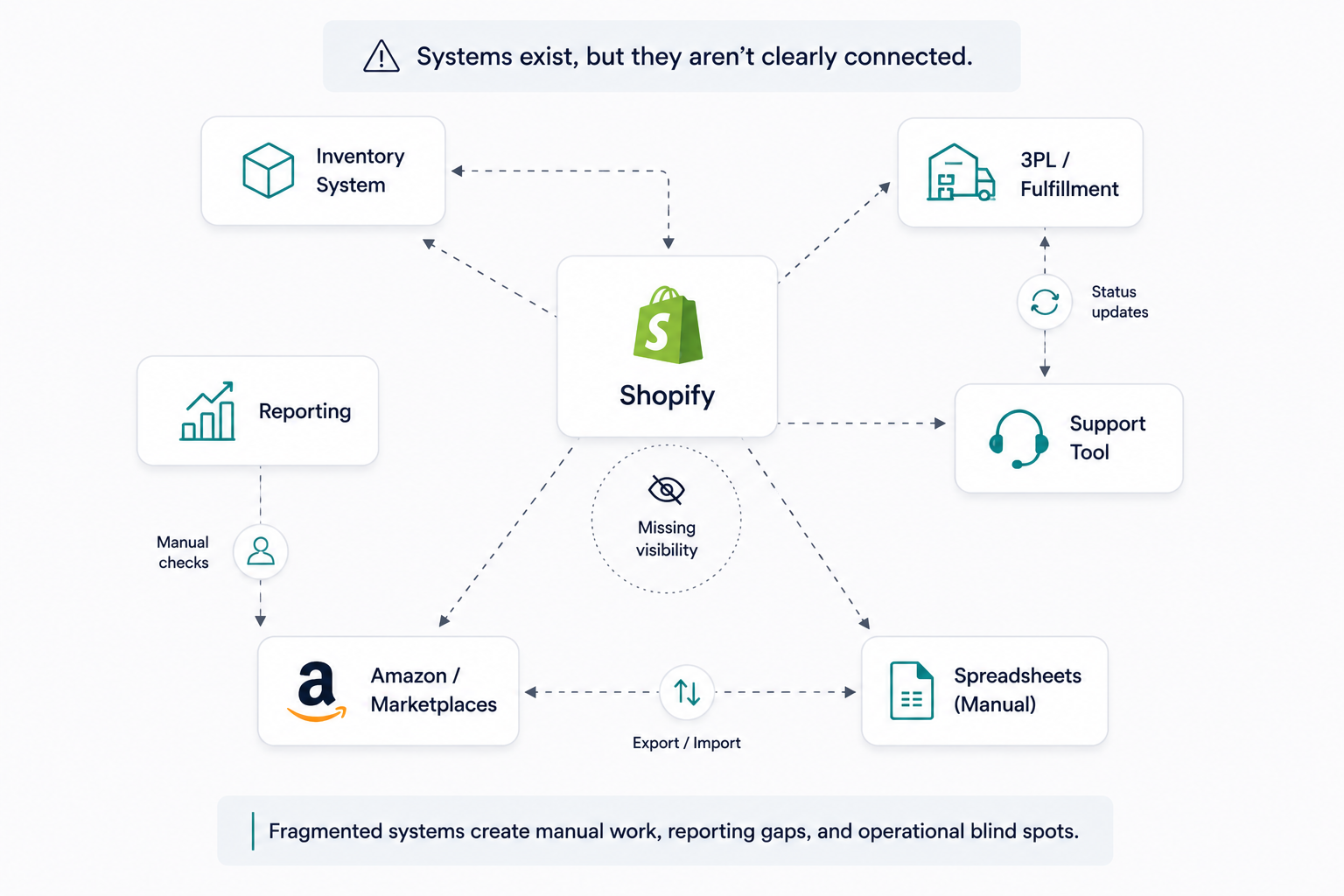
At first, the team can manage everything manually. Orders come through Shopify. Inventory gets checked in a separate tool. Fulfillment updates arrive from a warehouse, 3PL, Amazon, or internal operations team. Support checks order status when needed. Reporting gets pulled together in spreadsheets at the end of the week.
For a while, this works. But as order volume grows, more SKUs are added, more channels come online, and more people touch the operation, the business starts to feel harder to control. The tools may still work individually, but the workflow between them becomes less reliable.
That is where ecommerce operational visibility starts to break down. The issue is usually not one bad tool. It is the lack of a clear operating structure across orders, inventory, fulfillment, support, and reporting.
Operational Visibility Is More Than Having More Dashboards
Many ecommerce teams assume visibility means having more dashboards, reports, or tools. But operational visibility is not just about seeing more data. It is about trusting how work moves through the business.
A founder, COO, or Head of Operations should be able to answer basic operational questions without asking several people to check several systems.
Which orders are delayed?
Which SKUs are at risk of stockout?
Which fulfillment issues need attention?
Which numbers can leadership trust this week?
If the team needs to manually confirm every answer, the business does not have strong visibility. It has scattered information.
Why Visibility Breaks as Ecommerce Brands Grow
In the early stage, ecommerce operations often depend on a small group of people who know how everything works. One person knows how inventory is updated. Someone else knows which fulfillment issues are normal. A support lead knows where to check order delays.
The operation works because people carry the context. As the company grows, that becomes harder to maintain. More orders, products, channels, tools, and team members create more handoffs. The business starts depending on memory, manual checking, and informal communication.
Nothing about that is unusual. But when it happens repeatedly, it creates hidden operational drag.
The Problem Is Usually Between Systems
Most ecommerce brands already use useful software. Shopify manages orders. Klaviyo manages lifecycle messaging. Gorgias or Zendesk manages support. Amazon or other marketplaces manage channel sales. A 3PL, WMS, ERP, or inventory tool manages parts of fulfillment and stock movement.
The problem is that these systems often do not create one clear operational picture. Each tool may be doing its job, but the business still lacks visibility across the full workflow.
That creates practical questions:
Has this order actually moved, or is it only marked as created?
Is this inventory number accurate across DTC, Amazon, wholesale, and warehouse systems?
Does support know when fulfillment is delayed?
Who owns the follow-up when the numbers do not match?
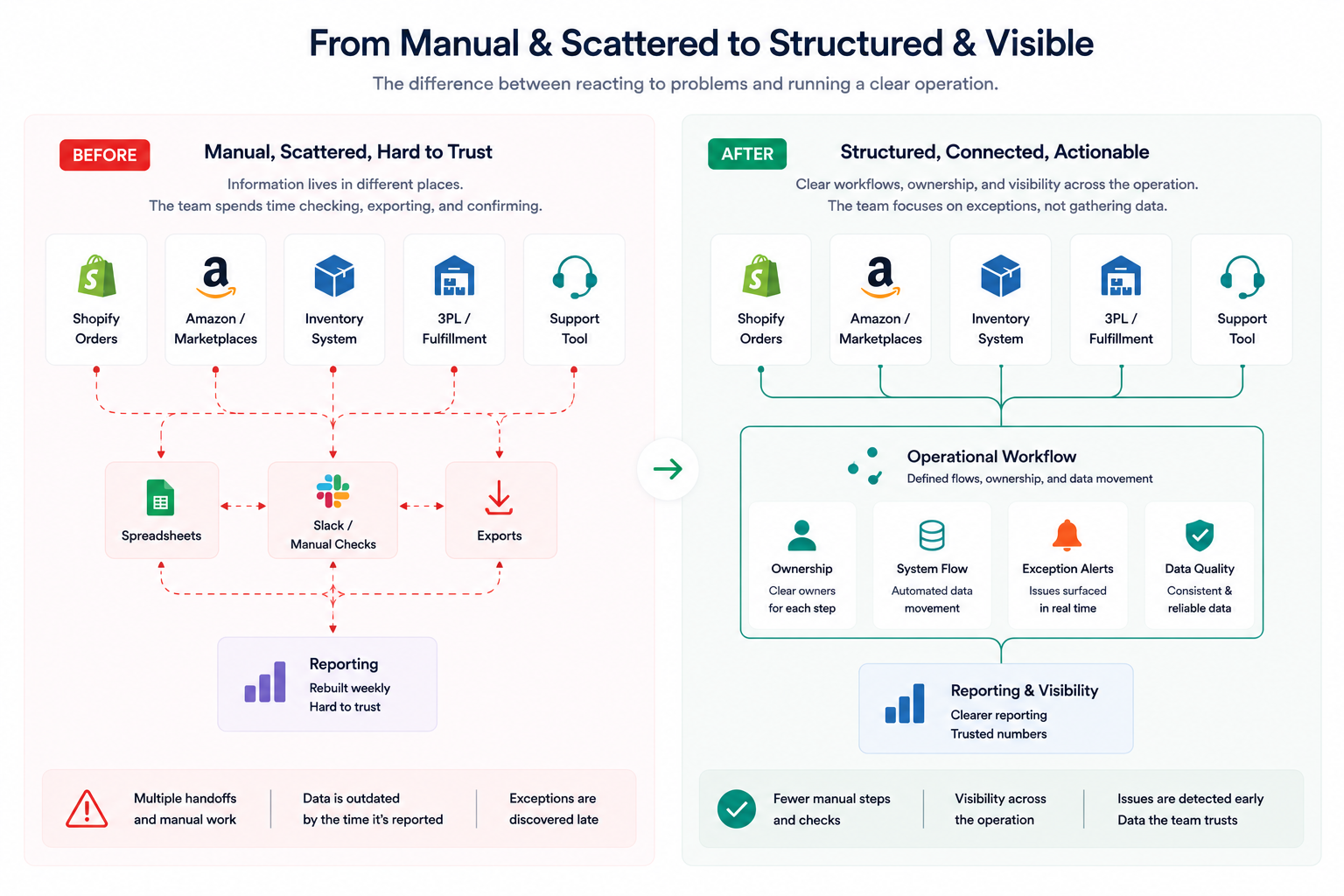
When those questions are not clearly answered, the team compensates with exports, spreadsheets, Slack threads, warehouse messages, and rebuilt reports. Manual coordination becomes the unofficial operating system.
Order, Inventory, and Fulfillment Visibility Break in Different Ways
Order visibility often breaks first. At low volume, teams can manually check exceptions. If a customer asks where an order is, someone can look it up. But as volume grows, support tickets, delayed fulfillment updates, returns, exchanges, and stuck orders become harder to manage manually.
Inventory visibility becomes more complicated when a brand sells through Shopify, Amazon, wholesale, subscriptions, marketplaces, or multiple fulfillment locations. Inventory is no longer just a stock count. It becomes a workflow: what is available, reserved, delayed, committed, and actually sellable.
Fulfillment visibility depends on clean handoffs. An order can be placed successfully and inventory can look available, but the customer experience still depends on what happens next. The warehouse or 3PL needs the right information. Shipping status needs to update. Exceptions need to be flagged. Support needs to know before the customer asks.
When those handoffs are unclear, teams check portals manually, learn about problems too late, and rely on Slack messages for exceptions.
Manual Reporting Is Usually a Symptom
Many ecommerce teams treat manual reporting as the problem. But manual reporting is usually a symptom of a deeper issue: the business does not have reliable operational data flows.
If a weekly report requires exports from Shopify, Amazon, a 3PL, support software, finance tools, and spreadsheets, the team is not just building a report. They are manually reconstructing the business.
That makes reporting slow, fragile, and less trusted. By the time the report is complete, the data may already be outdated. If one person owns the spreadsheet logic, the business depends on that person's memory. If systems disagree, leaders spend time debating the numbers instead of making decisions.
The better question is not "How do we make this spreadsheet faster?" The better question is "Why does this report need to be rebuilt manually in the first place?"
Automation Should Not Be the First Step
It is tempting to solve visibility problems by adding automation immediately. That can help, but only if the workflow is already understood.
If the current process is unclear, automation can make confusion move faster. It can push incorrect data into more places, trigger actions based on incomplete rules, or create alerts that nobody owns.
Before automating, ecommerce teams should understand what starts the workflow, which systems are involved, who owns each step, where handoffs happen, what information needs to move, and which exceptions require attention.
Automation works better when the operating model is clear. If the business does not understand how work should move, it is too early to automate the workflow end to end.
What Ecommerce Teams Should Review First
Before investing in more tools or automations, ecommerce teams should review the workflows where visibility breaks most often.
Start with order status workflows. What happens after an order is placed? Where does it go? Which system owns the next step? How does the team know if fulfillment is delayed?
Then review inventory updates. What is the source of truth? How does inventory change across channels? What happens when Shopify, Amazon, the warehouse, and a spreadsheet disagree?
Next, map fulfillment exceptions and reporting workflows. Who sees issues first? Does support know before the customer asks? Which data sources feed weekly reporting? Which numbers are trusted?
These questions reveal whether the business has a workflow visibility issue, not just a tooling issue.
How BChanel Thinks About Ecommerce Operational Visibility
At BChanel, we do not see operational visibility as a dashboard problem first. We see it as a workflow and system design problem.
The goal is not to add automation on top of a messy process. The goal is to understand how work moves today, where visibility breaks, which systems are involved, and what needs to be redesigned before automation is implemented.
That starts with an operational assessment of the current workflow.
For ecommerce teams, this may include reviewing order visibility, inventory updates, fulfillment handoffs, support escalations, reporting processes, and the manual checks that happen between systems.
From there, the next step is workflow architecture: designing how the process should move across tools, teams, and ownership points. Only after that does automation become useful.
The Real Goal: A Business That Is Easier to Trust
Operational visibility is not about watching every task in real time. It is about building an ecommerce operation that is easier to trust.
The founder should trust the numbers. The COO should trust the workflow. Support should trust order status. Operations should trust inventory updates. Leadership should trust that exceptions are visible before they become bigger issues.
For growing ecommerce brands, this is often the difference between scaling with control and scaling with constant manual cleanup.
If your team is checking multiple systems to answer basic operational questions, it may be time to review where visibility is breaking.
FAQ
What is ecommerce operational visibility?
It is the ability to clearly understand how orders, inventory, fulfillment, support, and reporting move across the business without relying on constant manual checks.
Why do ecommerce brands lose visibility as they grow?
Visibility often declines because order volume, sales channels, SKUs, fulfillment partners, and tools grow faster than the operating structure around them.
What are common signs of poor ecommerce visibility?
Common signs include manual reporting, inventory mismatches, delayed fulfillment updates, support teams chasing order status, unclear ownership, and dashboards the team does not fully trust.
Should ecommerce teams automate visibility problems?
Not immediately. Teams should first map the workflow, clarify ownership, identify system gaps, and understand where data needs to move.
What workflows should ecommerce brands review first?
Start with order status updates, inventory synchronization, fulfillment exceptions, support escalations, and manual reporting. These areas usually reveal where visibility breaks.